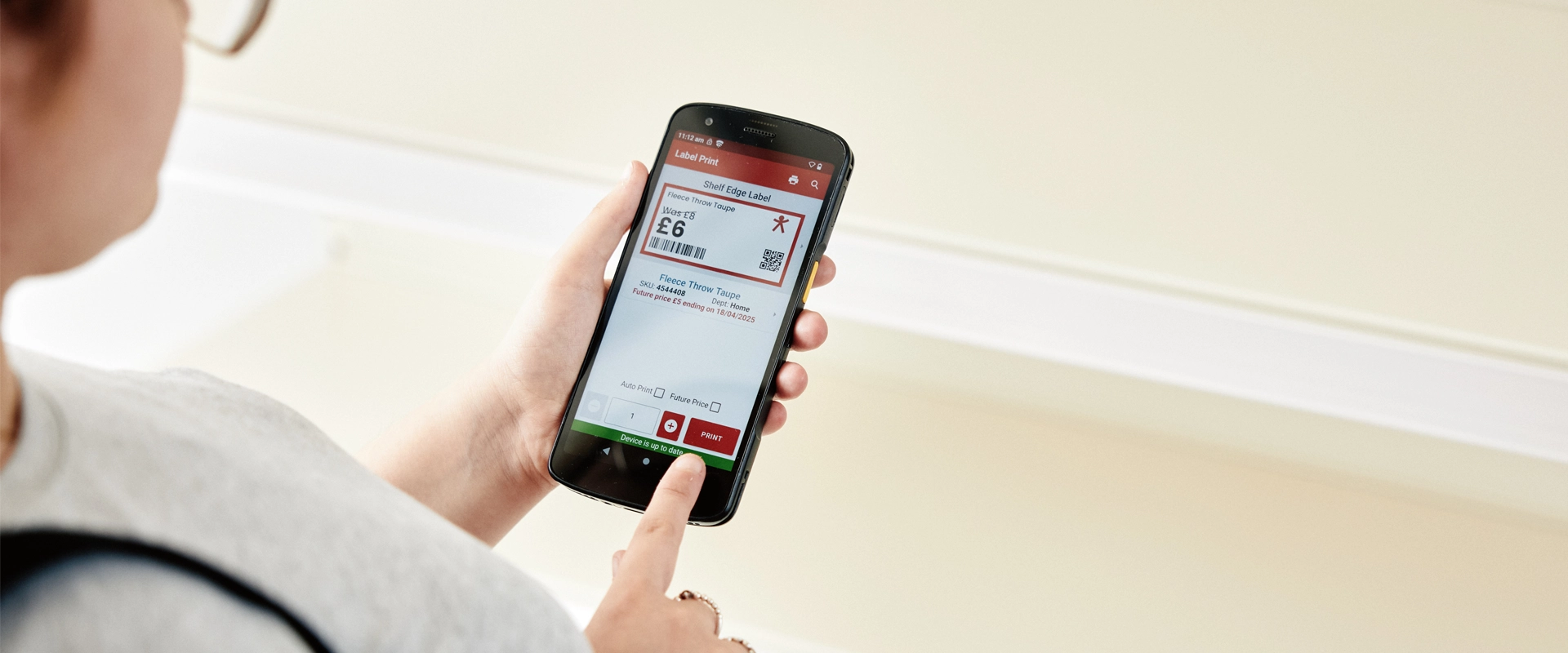
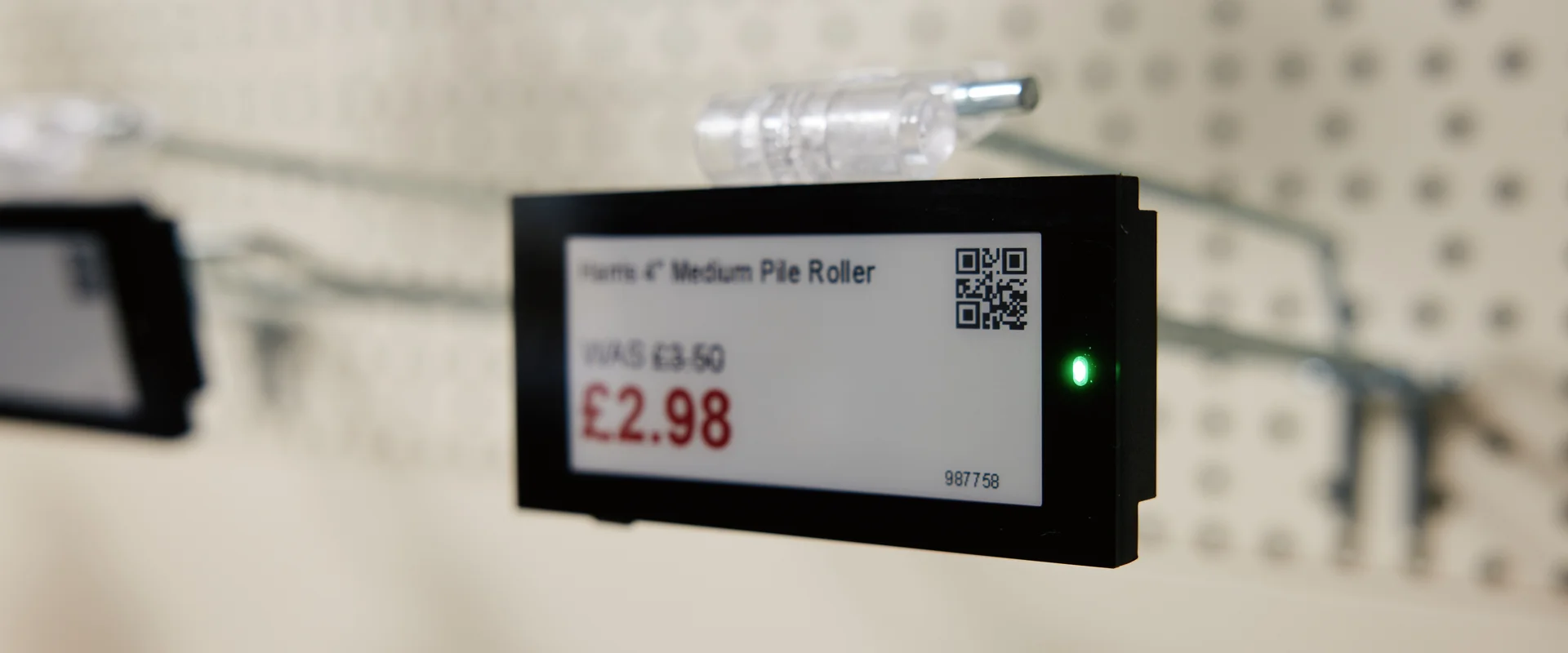
What Is an Electronic Shelf Label?
An ESL is a small digital display used at the shelf edge to show prices and product information, which can be updated wirelessly from a central system.
The label itself is only one part of an ESL system. The displays communicate wirelessly with the retailer’s systems, usually through communication equipment such as an RF gateway or base station installed in the store. Behind this is management software that connects the shelf-edge labels with pricing and product information. When a price or other piece of information changes, the updated data can be sent to the relevant labels without a member of the store team having to print and replace a paper ticket.
The exact capabilities vary between systems, but the principle remains the same: information displayed at the shelf edge is managed digitally rather than being fixed on a printed label.
From Electronic Price Tags to Today’s ESLs
The idea behind electronic shelf labelling is not new. Early electronic price labels used relatively simple display technology, including LCD displays similar to those found in calculators. Early systems also used wireless communication to send price changes to labels.
Today’s ESLs have evolved considerably. E-paper displays provide a more paper-like appearance while wireless communication, software and battery technology improvements have made it practical to manage large numbers of labels across a store.
As retailers have adopted ESLs at greater scale, the technology has also become part of wider retail digitalisation. Rather than treating the shelf label as a standalone price display, retailers can connect it to the systems already used to manage products, prices and promotions. The result is a shift from manually maintaining shelf-edge information to managing it centrally. This is particularly relevant for retailers managing large numbers of products or multiple stores, where changing paper labels can require significant amounts of colleague time.
This centralised approach is one of the defining features of ESL technology. The value is not simply that a paper label has been replaced by a digital one; it’s that the information displayed at the shelf can become part of a connected, centrally managed system.
How Do Electronic Shelf Labels Work?
ESLs receive wireless updates from a central management system. In-store communications infrastructure sends new pricing and product information to the relevant labels, so the shelf-edge display can be updated without replacing a paper label. An electronic shelf label system typically has four main components:
1) Central Management System
The process starts with the retailer’s central systems, where pricing, promotions and product information are managed. An ESL solution can connect with existing pricing, ERP or other retail systems, allowing information to flow from the systems the retailer already uses rather than requiring every change to be entered manually.
2) RF Gateway or Base Station
The central system needs a way to communicate with the labels in-store. This is where an RF gateway or base station comes in.
The gateway provides the wireless connection between the retailer’s systems and the ESLs, sending updates to the relevant labels. The exact communication technology and network architecture vary between ESL manufacturers and solutions, but the principle is the same: information is transmitted wirelessly rather than requiring a colleague to physically replace each label.
For larger stores or deployments with thousands of labels, the communications infrastructure must provide reliable coverage, so updates reach the relevant shelf-edge displays.
3) The Electronic Shelf Label
At the shelf edge is the ESL itself. Most modern labels use an e-paper or e-ink display, designed to provide a paper-like appearance while consuming very little power. Each label also contains a small radio for receiving information and a battery designed to support long-term operation.
The exact features vary between manufacturers and models. Some smart shelf labels include programmable LEDs that can help store colleagues locate a particular product or shelf position. Others may include buttons or further features designed to support in-store tasks.
This means the label can be more than a digital version of a paper price ticket. Depending on the system, it can support a range of store operations while continuing to perform its core role of displaying accurate product and pricing information.
4) The Update Flow
The final part is the process that connects everything.
Imagine a retailer changes the price of a product from £3.00 to £2.50. Rather than printing a new paper label and sending a colleague to the shelf, the price change is made in the retailer’s central system.
The ESL system identifies the relevant product and sends the updated information through the in-store communications infrastructure to the corresponding electronic shelf label. The label then updates its display to show the new price.
What Do Electronic Shelf Labels Look Like?
An ESL is a compact, shelf-mounted display designed to fit into the existing shelf-edge environment. Retailers can choose different sizes and formats depending on the products, departments and types of information they want to present.
Smaller electronic shelf edge labels are typically designed for individual products and can be only a few centimetres wide. Larger formats provide more space and can be used for promotional displays, shelf-edge messaging or other point-of-sale content. SOLUM, for example, offers ESL formats ranging from 1.6-inch displays through to 12.2-inch models.
The appearance also varies between manufacturers and models. Some digital price tags use a simple black-and-white display, while others support additional colours. Certain models include programmable LEDs alongside the main display, which can make individual labels more visible within a busy shelf environment.
Electronic Shelf Labels in UK Retail
Electronic shelf labels are becoming increasingly visible in UK stores. Tesco, for example, announced in June 2026 that it was rolling out ESLs across 3,000 large-format and convenience stores over a two-year period.
The Tesco example also illustrates an important point about ESLs: they do not necessarily look radically different from the paper labels shoppers are already familiar with. The physical format remains relatively unobtrusive, while the information displayed on it can be changed digitally.
What Information Can ESLs display?
An ESL can display much more than a product’s selling price. The information available depends on the ESL technology, the retailer’s systems and how the solution is configured, but common uses include:
- Product name and price: The core information shoppers need to identify a product and its current selling price.
- Unit pricing: Such as the price per kilogram, litre or other relevant measurement, supporting product comparison.
- Promotional pricing and messaging: Sale prices, offers and other promotional information can be displayed alongside or instead of the standard price.
- Barcodes and QR codes: Scannable codes can provide a link between the shelf edge and digital information or services.
- Product information: Additional details about a product can be displayed where the retailer chooses to make them available at the shelf.
- Stock or replenishment information: Some implementations can provide information or prompts to support product availability and replenishment processes.
- Visual prompts for store teams: Labels can be used to highlight products or provide visual cues for colleagues carrying out particular in-store tasks.
Some ESL systems can also support interactions beyond the information displayed on the label. For example, near-field communication (NFC) can allow a compatible smartphone to interact with an ESL. Depending on the implementation, this could take shoppers to additional product information, user guides, videos, loyalty schemes, or other digital experiences.
Other applications can include displaying product reviews or ratings at the shelf edge, giving customers additional information while they’re considering a purchase. The result is that an ESL doesn’t have to function simply as a digital version of a paper price ticket. The same shelf-edge technology can provide pricing, product and promotional information, while also supporting digital interactions and store processes.
What Are the Benefits of ESLs?
The main benefits of ESLs are faster price changes, a lower risk of manual pricing errors between shelf and till, greater control over promotional pricing, and store teams freed from manual pricing tasks to spend more time with customers.
For retailers managing large product ranges or multiple stores, these benefits can make a difference to both day-to-day store operations and pricing consistency.
Faster, More Controlled Price Changes
Changing prices across a large store can involve hundreds or thousands of shelf labels. With traditional paper labels, this means printing new labels, locating the right products and replacing each one manually.
Electronic shelf labels allow price changes to be sent to the relevant labels electronically, reducing the time store teams need to spend on manual price changes. They can also support centrally managed and scheduled promotional pricing, allowing offers to go live and end at planned times across multiple stores.
For retailers running frequent promotions or managing large product ranges, this can make it easier to implement pricing changes consistently across the estate without relying on teams to replace paper labels at each location.
Pricing Accuracy and Consistency
Manual price changes create opportunities for discrepancies between the price held in a retailer’s central systems, the price shown at the shelf edge and the price charged at the till.
An ESL system can help retailers keep these prices aligned by connecting shelf-edge pricing with the systems that manage product and pricing data. This can reduce the risk of errors caused by missed or incorrectly replaced labels, while supporting more consistent pricing across stores.
More Control Over Promotional Pricing
Promotions can involve large numbers of products, stores and specific start and end times. Electronic price labels can support centrally managed and scheduled price changes, allowing promotional pricing to go live and end at planned times.
For retailers running frequent promotions, this can make it easier to manage changes consistently across the estate without relying on teams to replace paper labels at each location.
Less Paper and Label Waste
ESLs also reduce the ongoing need to print and dispose of paper shelf labels every time a price changes. For retailers making frequent updates across a large estate, reducing this repeated printing can contribute to lower paper and consumable use, alongside the operational time saved.
What Do ESLs cost?
There is no single meaningful price for an ESL deployment. The overall cost depends on factors including the size of the store estate, the number and type of labels required, the hardware supplier, integration requirements and the commercial model used.
The main areas of investment typically include:
- Hardware: Electronic labels, gateways or other communications equipment.
- Fixtures and fittings: The equipment needed to mount and position labels at the shelf edge.
- Software and integration: The ESL management platform and connections to existing retail, pricing or ERP systems.
- Installation: Deploying and configuring the system across stores.
- Ongoing support: Software, maintenance and other costs associated with running the system over time.
The right way to assess ESL cost is to look at the whole deployment rather than the price of an individual label. ESL costs need to be considered alongside the potential return, including the time and resources currently spent on manual price changes and the impact of pricing errors.
For a more detailed look at the factors that influence cost and how to build the business case, see TPP Retail’s guide to building a business case for electronic shelf labels.
Is ESL Right for Every Retailer?
ESLs can be particularly relevant for retailers where manual price changes are a regular operational task. However, they are not necessarily the right investment for every retail environment.
ESL is likely to be most relevant where retailers have:
- Large numbers of SKUs: More products mean more labels to manage when prices change.
- Frequent price changes: Retailers changing prices regularly have more opportunity to save time through automated updates.
- Promotional-heavy operations: Frequent promotions can make centrally managed price changes more valuable.
- Multiple stores: Managing pricing consistently across a large estate can be more complex when changes rely on manual processes.
- Significant store time spent on pricing: Where colleagues regularly spend time printing, finding and replacing labels, there may be a stronger operational case for automation.
For retailers with smaller product ranges, relatively stable pricing or very few price changes, the benefits may be less significant. In these environments, the investment required for an ESL system may be harder to justify.
If you’re considering an ESL rollout, it’s also worth understanding the common challenges that can affect an ESL project. Our guide to common ESL project mistakes covers some of the areas retailers should consider before getting started. For those ready to explore the technology itself, TPP Retail’s Label IQ ESL solution provides more information on the offering.
Frequently Asked Questions
1) What is the difference between electronic shelf labels and digital price tags?
ESLs and digital price tags generally refer to the same technology: digital displays used at the shelf edge to show prices and other product information. “Digital price tags”, “electronic price labels” and “electronic shelf labels” are all terms used in retail, although ESL is the most common industry abbreviation.
2) Do electronic shelf labels need Wi-Fi?
Electronic shelf labels communicate wirelessly, but they do not necessarily connect directly to Wi-Fi. The exact communication technology varies by manufacturer and may include proprietary radio-frequency (RF) protocols or Bluetooth Low Energy (BLE). Wi-Fi can be used elsewhere in the system to connect gateways or access points to central management systems.
3) How long do electronic shelf label batteries last?
Electronic shelf label batteries can typically last around 7–10 years, although battery life varies between systems. Factors including label size, colour or monochrome display, how frequently labels are updated, the manufacturer and operating conditions can all affect battery life.
4) When are electronic shelf labels worth considering?
Electronic shelf labels are most relevant where retailers have large numbers of SKUs, frequent price changes or significant amounts of time spent manually changing shelf labels. Multi-site and promotion-heavy retailers may also benefit from being able to manage pricing changes centrally, but the case depends on the operational cost and effort of the retailer’s existing process.
5) What retailers use electronic shelf labels in the UK?
A growing number of UK retailers use or are rolling out electronic shelf labels, including Morrisons, Waitrose, ASDA and Currys. Morrisons announced plans for ESLs across 497 supermarkets, while ASDA has rolled them out across more than 250 Express stores; Currys has rolled out electronic shelf-edge labelling across its UK&I estate.
Taking the Next Step with ESL
Electronic shelf labels give retailers a way to manage shelf-edge pricing and product information digitally, reducing the need for manual label changes and giving teams greater control over pricing across stores. For retailers with large product ranges, frequent price changes or significant manual pricing tasks, ESL can offer operational benefits alongside greater pricing consistency.
Whether ESL is the right investment depends on your own stores, systems and processes. You can also find out more about our electronic shelf label solution and how it can support retail pricing and shelf-edge management. If you have a specific question about electronic shelf labels that we haven’t covered here, contact us and our team will be happy to help.